
Letters and documents from a distinguished collector
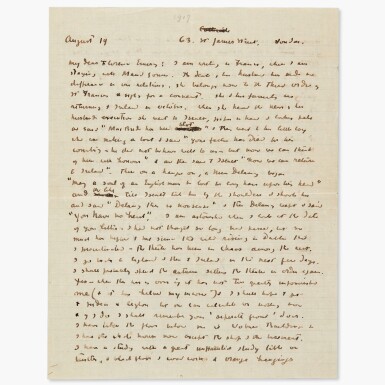
W.B. Yeats | Autograph letter signed, to Florence Emery, about Maud Gonne and the Easter Rising, 19 August 1916
Estimate
7,000 - 10,000 GBP
We may charge or debit your saved payment method subject to the terms set out in our Conditions of Business for Buyers.
Read more.Lot Details
Description
W.B. Yeats
Autograph letter signed, to Florence Emery, on the aftermath of “this wild rising in Dublin”, written while Yeats was staying with Maud Gonne in France and describing her response to her husband’s execution for his role in the Uprising (“…When she heard the news of her husband’s execution she went to Iseult, paper in hand & looking pale and said ‘MacBride has been shot’ & then went to her little boy who was making a boat & said ‘Your father has died for his country — he did not behave well to us — but now we can think of him with honour’ and then said to Iseult ‘Now we can return to Ireland’…”), continuing with personal news, including that the Abbey Theatre is in chaos, that “Ezra [Pound] and his wife are happy”, and detailing his latest writings, 2 pages, large 4to, ["Colleville" deleted] 63 St James Street, London, 19 August [1916]
“…My more elaborate piece of mystical writing is a long terminal essay but where I have put the results of my spiritualist research. I have also written notes on Witchcraft & the like. It will be an important work, a necessary authority. It just occurs to me that I never sent you a copy of my autobiography "Reveries over Childhood & Youth" […] I am just bringing out some poems but you will know them all in my sister’s editions I suspect. I have finished also a first draft of 'Memoirs' up to date which are not to be published till after my death […] It is a very candid book & will be quite unpublishable unless the world grows more free spoken…”
AN EXCEPTIONAL LETTER WRITTEN AT A TURNING POINT IN YEATS’S LIFE AND IN IRISH HISTORY. Maud Gonne was the great love of Yeats’s life. After repeatedly refusing Yeats’s proposals of marriage, in 1903 she had married the solider and revolutionary John MacBride, but the marriage was deeply unhappy and collapsed within two years. Maud Gonne had instituted divorce proceedings in Paris when she came to believe that MacBride had sexually assaulted her ten-year-old daughter Iseult, but MacBride returned to Dublin and refused to agree to divorce — as a result Maud Gonne was unable to return to Ireland without risking custody of their son Sean. However, as this letter shows, she reclaimed her relationship with MacBride’s when his leading role in the Easter Uprising and subsequent execution transformed him into a martyr to the Irish nationalist cause. She wore mourning, took his name, and castigated Yeats for his ambivalent representation of MacBride in "Easter 1916", which places him among the glorious dead for whom "a terrible beauty is born" but recalls that he had “done most bitter wrong/ To some who are near my heart”. Yeats states in this letter that “The death of her husband has made no difference in our relations”: this was true in that he had proposed marriage to her once more during the visit, and had once more been rejected (following this final rejection Yeats also proposed to her daughter Iseult).
Yeats’s correspondent here was another of the remarkable women to whom he was attracted throughout his life, Florence Emery (née Farr), an actor, composer, director, feminist, and mystic. In 1912 she had left England for Ceylon, where she was principal of a Tamil girl’s school founded by Sir Ponnambalam Ramanathan. Yeats writes in this letter that after the war is over he hopes to travel to the East and visit her in Ceylon, but she died of cancer in Ceylon in 1917. Emery shared Yeats’s interest in the occult, and like him was a member of the Order of the Golden Dawn, which is why Yeats is particularly keen in this letter to ensure she is kept up to date with his mystical writings.
PROVENANCE:
Sale in these rooms, 21–22 July 1988, lot 272
You May Also Like


