
From the chess collection of Lothar Schmid
Giulio Benso
The chess players
No reserve
Estimate
2,000 - 3,000 GBP
We may charge or debit your saved payment method subject to the terms set out in our Conditions of Business for Buyers.
Read more.Lot Details
Description
Giulio Benso
Pieve del Tecco 1601 - 1668
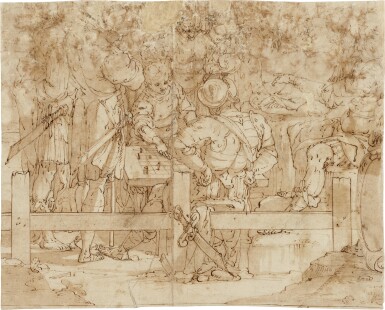
The chess players
Pen and brown ink, brown wash over traces of black chalk, indented for transfer;
bears old numbering 20 in pen and ink on the verso.
280 by 354 mm
A. Bachelen, according to an inscription (possibly on a mount now lost)
Newcome-Schleier, 'Giulio Benso', Paragone, 1979 (September), p. 35, pl. 34b, p. 40, note 30;
S.C. Lumetta, The Art of Giulio Benso. Genoese Figure between Mannerism and Baroque, Ph.D. dissertation, Art and Art History. Université Paris sciences et lettres; Università degli studi di Roma “Tor Vergata”, no. D153, reproduced
The present sheet, intended for transfer, is a discarded idea for an engraving of the same subject by Camillo Cungi (1570/80-1649), known in different impressions. The subject of this drawing by the Genoese artist Giulio Benso is an allegorical representation of the story of Palamedes inventing the game of chess during the Trojan War. It depicts a chess game between a boy and a soldier, in the presence of a crowned female figure seated under a baldachin, along with a group of soldiers.
Besides the present sheet and the preceding lot, two further drawings by Benso associated with this same composition are known, each with small variations, respectively in a private collection and in the National Museum in Warsaw.1 The commission is undocumented, but the drawings and the related engraving have been dated by Lumetta to 1650 (see Literature).
For more information, see the note to the previous lot.
1. Respectively: New York, Christie's, 26, January 2023, lot 11; previously with Colnaghi, London (Master Drawings, New York, 1989, no. 16, ill.); Warsaw, National Museum, Rys. Ob. d. 295; see, Lumetta, D.152 and D.154, both reproduced
You May Also Like


