
Letters and documents from a distinguished collector
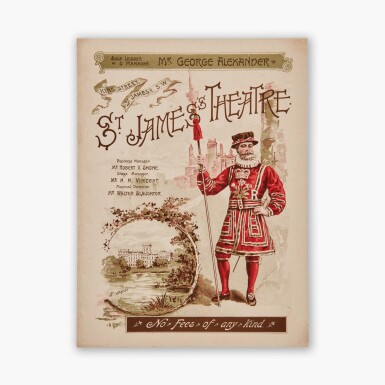
Oscar Wilde | Two theatre programmes for the first production of The Importance of Being Earnest, 1895
No reserve
Estimate
3,000 - 5,000 GBP
We may charge or debit your saved payment method subject to the terms set out in our Conditions of Business for Buyers.
Read more.Lot Details
Description
Oscar Wilde
Two illustrated theatre programmes for the first production of The Importance of Being Earnest, at the St James’s Theatre on King Street. London: Mardon, Son & Hall, 1895. 4 pages, 4to (250 x 190 mm), from the beginning and end of the play's run, the latter omitting the author's name following his arrest:
i) St James’s Theatre | […] Thursday, February 14th, 1895, | and every evening at 8.45. | The Importance of Being Earnest, | a Trivial Comedy for Serious People, | by Oscar Wilde.
ii) St James’s Theatre | […] Produced Thursday, February 14th, 1895. |To-night at 9, | (Last Nights of) | The Importance of Being Earnest, | a Trivial Comedy for Serious People.
OSCAR WILDE: HIS GREATEST PLAY AND PERSONAL CATASTROPHE. These two copies of the programme for the first production of The Importance of Being Earnest offer poignant evidence of Wilde’s rapid change of fortune in the early weeks of 1895.
Wilde was at the height of his public success when Earnest opened at the St James’s Theatre. The opening came on the back of three West End successes in as many years, and The Ideal Husband was still in production at the nearby Haymarket Theatre when Earnest premiered on Valentine’s Day 1895. It was produced by actor-manager George Alexander, who had also produced Lady Windermere’s Fan, and was met with ecstatic reviews. However, the play’s opening also triggered Wilde’s downfall: the Marquess of Queensberry intended to attend the first night in order to throw a bunch of carrots at the author in protest at his relationship with his son. When he was prevented from coming to the play, Queensberry sent Wilde his card with a note accusing him of homosexuality. Events moved quickly in the weeks that followed, and by early April Wilde was committed to prison and awaiting trial.
The public opprobrium that followed Wilde’s arrest drove his greatest play from the stage. George Alexander removed Wilde’s name from the programme on 6 April but the play closed one month later, after a run of just 86 days. The two programmes also show the replacement of Rose Leclercq, the first Lady Bracknell, with Emily Mary Kate Saker.
You May Also Like
![A.A. Milne | Pictorial postcard of Milne, Christopher Robin, and Pooh Bear, written partly as if from Pooh, [1928–1929]](https://dam.sothebys.com/dam/image/lot/dd3b318a-acdb-4206-98e2-06830abc1717/primary/extra_small)


![Luis Ramírez de Lucena | Repetición de amores y arte de ajedrez, [Salamanca, 1497], the oldest surviving book on the game of chess](https://dam.sothebys.com/dam/image/lot/18a74f31-d1c7-4e1b-bb3e-aa946f3cc760/primary/extra_small)


![Lactantius | Opera. [Subiaco, 1465], first edition of the first dated book printed in Italy, a landmark publication from the birth of printing](https://dam.sothebys.com/dam/image/lot/a4fe4f20-b69d-4369-9d5a-ed62fd474fa6/primary/extra_small)
