
From the chess collection of Lothar Schmid
Automaton Chess Player | A group of 10 rare volumes on the purported Enlightenment precursor to modern-day artificial intelligence
Estimate
15,000 - 20,000 GBP
We may charge or debit your saved payment method subject to the terms set out in our Conditions of Business for Buyers.
Read more.Lot Details
Description
A group of 10 volumes concerning the Automaton Chess Player, comprising:
(i) L. D[utens]. Lettres sur un automate, qui joue aux échecs. 1772. 8vo (179 x 119 mm), title-page with woodcut device, modern buckram boards, pamphlet detached from binding, edges lightly browned and frayed, endleaves replaced, upper board slightly soiled
(ii) Johann Philipp Ostertag. Etwas über den Kempelischen Schachspieler; eine Gruppe philosophischer Grillen. Frankfurt and Regensburg, 1783. 8vo (176 x 115 mm), original paper wrappers, leaves uncut, wrappers slightly frayed
(iii) Karl Gottlieb von Windisch. Briefe über den Schachspieler des Herrn von Kempelen. Pressburg: Anton Löwe, 1783. 8vo (174 x 100 mm), original blue paper wrappers, leaves uncut, some unopened; top edge and wrappers slightly soiled
(iv) C. F. Hindenburg. Ueber den Schachspieler des Herrn von Kempelen, nebst einer Abbildung und Beschreibung seiner Sprachmaschine. Leipzig: in der Johann Gottfried Müllershen Buchhandlung, 1784. FIRST EDITION, 8vo (214 x 113 mm), numerical diagrams in text, folding engraved plate of the speaking machine at end, red half morocco over boards stamped with chess pieces, deckle edges, slight browning and occasional spotting
(v) J. J. Ebert. Nachricht von dem berühmten Schachspieler und der Sprachmaschine des K. K. Hofkammerraths Herrn von Kempelen. 1785. 8vo (190 x 118 mm), two folding engraved plates, green half morocco over boards stamped with chess pieces, deckle edges, worming to first two leaves, endleaves renewed
(vi) [Philip Thicknesse]. The speaking figure, and the automaton chess-player, exposed and detected. London: John Stockdale, 1784. 8vo (203 x 122 mm), engraved frontispiece, publisher's 4-page advertisement at end, speckled half calf over marbled boards, frontispiece soiled, shaved, and remounted (possibly from another copy), endleaves renewed
(vii) An Oxford Graduate [Robert Gray, Jr.?]. Observations on the automaton chess player. London: J. Hatchard, 1819. 8vo (202 x 126 mm), half-title, title, unbound sheets, housed in paper envelope addressed to "A Buschke, Books-Serials-Chess Literature", light soiling to both endleaves, envelope cut open at edges
(viii) W.J. Hunneman. Chess. A selection of fifty games from those played by the automaton chess-player during its exhibition in London. London: W. Pople, 1820. 12mo (167 x 100 mm), errata leaf at end, brown cloth boards, a few leaves frayed, some spotted and some lightly ink blotted, not affecting text, soiling to p. iv, 5.5cm closed tear to p. 49 (not affecting text)
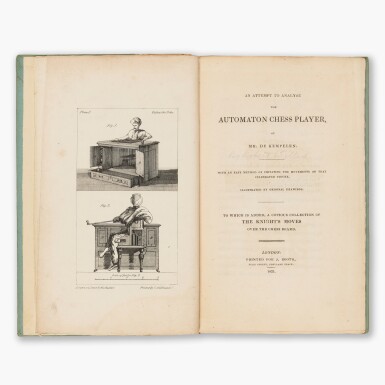
(ix) Robert Willis. An attempt to analyse the automaton chess player, of Mr. de Kempelen. London: Printed for J. Booth, 1821. FIRST EDITION, 8vo (140 x 134 mm), half-title, 10 lithographed plates (including frontispiece) by Willis printed by C. Hullmandel, plain boards, mild dampstaining in final few leaves, endleaves renewed, boards soiled, joints cracked
(x) Observations upon the automaton chess player of von Kempelen. Philadelphia: J. Dobson, 1827. 8vo (221 x 143 mm), four engraved diagrams in-text, publisher's printed wrappers, spotting and light dampstaining throughout, edges frayed
A GROUP OF RARE WORKS ON THE CHESS-PLAYING AUTOMATON: THE PURPORTED ENLIGHTENMENT PRECURSOR TO MODERN-DAY ARTIFICIAL INTELLIGENCE.
The Hungarian inventor Wolfgang von Kempelen's chess-playing automaton, the "Mechanical Turk", was presented to Empress Maria Theresa in 1769. The machine consisted of a life-sized model of a human head and torso, dressed in Turkish robes and a turban, seated behind a large cabinet on top of which a chessboard was placed. The machine appeared to be able to play a strong game of chess against a human opponent, but was in fact merely an elaborate simulation of mechanical automation: a human chess master concealed inside the cabinet would puppeteer the Turk from below by means of a series of levers. With a skilled operator in control, the Turk was toured and exhibited for 84 years around Europe and the Americas, winning most of the games played during its demonstrations. The Turk played and defeated many challengers, famously including statesmen such as Napoleon Bonaparte and Benjamin Franklin. Napoleon's game against the Turk in 1809 is particularly noteworthy; eyewitnesses claimed that Napoleon's repeated illegal moves were met with the Turk sweeping all the pieces off the board.
Although many had suspected the machine was faked, Robert Willis was the first to publish a correct explanation of the hoax, 51 years after its creation. Numerous other works were written on the Turk, both accurately and inaccurately describing the mechanism. The Turk continued, however, to be exhibited, winning most of the games played during its demonstrations until 1854, when it was destroyed in a fire. It was only after the loss of the Turk that the secret was fully revealed to the public, by the final private owner's son, Silas Mitchell. In his article for The Chess Monthly in 1857, Mitchell wrote that "There are no longer any reasons for concealing from the amateurs of chess, the solution of this ancient enigma".
For an inscribed copy of the French translation of item (iii), see lot 34.
PROVENANCE:
(i) Cleveland Public Library: bookplate; (v) Poul Hage, Danish chessplayer (1906-1984): bookplate; (vi) Meindert Niemeijer, Dutch chess-player and collector (1902-1987): bookplate; Koninklijke Bibliotheek, The Hague: sold duplicate stamp; (ix) Brooklyn Public Library: library stamp, shelfmark to lower board
LITERATURE:
(iii) VDL Geschichte II, p. 338; KB 4018; (iv) VDL Geschichte II, p.339; Schachlitteratur 1121; KB 4024; (vi) ESTC N23931; Toole Stott 417
You May Also Like
![Jacobus de Cessolis | De ludo scachorum, Toulouse, [c.1494], the Syston Park-von der Lasa copy](https://dam.sothebys.com/dam/image/lot/93529276-069a-4535-a1c4-67c3ccc359d2/primary/extra_small)
![Castiglione | Il libro del cortegiano. [Venice], April 1528, first edition, in a magnificent binding by Jean Picard for Jean Grolier](https://dam.sothebys.com/dam/image/lot/b5c5bb44-26ff-4321-8391-44a14b74e9dc/primary/extra_small)
![Jean Pierre Elme Leduc [Saint-Elme-le-Duc] | Two manuscript volumes](https://dam.sothebys.com/dam/image/lot/80d8d8fb-cbd3-4c67-8a25-c8b064f6d4b5/primary/extra_small)


![Pedro Damiano da Odemira | Libro da imparare giocare a scachi, [?Rome, after 1524], fifth edition, Niemeijer copy](https://dam.sothebys.com/dam/image/lot/fb6f665d-0b6c-4695-9a07-0727da2684ce/primary/extra_small)


