
Property from an Important Private Collection, Monaco
Lucio Fontana
Concetto Spaziale
Estimate
50,000 - 70,000 EUR
Lot Details
Description
Property from an Important Private Collection, Monaco
Lucio Fontana
1899 - 1968
Concetto Spaziale
signed and dated 54
graffiti on engobed terracotta
diam. 21 cm
Executed in 1954.
Galleria Martano, Turin
Private collection, Monaco (acquired from the above)
Enrico Crispolti, Lucio Fontana, Catalogue Raisonné de sculptures, peintures, environnements Vol I, Milan 2006, no. 54 SC 27, p. 310, illustrated
Luca Massimo Barbero, Lucio Fontana, Catalogue Raisonné des sculptures céramiques Vol II, Milan 2022, no. 54 SC 27, p. 593, illustrated
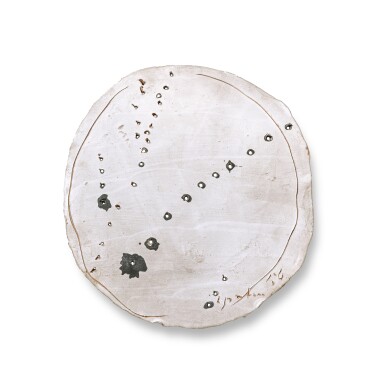
In 1954, neither Sputnik nor Gagarin had yet crossed the sky. And yet, on this disc of terracotta, Fontana was already piercing space.
The theoretical foundation for this gesture had been laid as early as the First Spatialist Manifesto of 1947, in which the artist articulated his thinking with almost prophetic clarity: “We refuse to consider science and art as two distinct phenomena. Artists anticipate scientific deeds.” Yet it is in his own words, spoken some years later, that Fontana most directly captures what this work embodies: “I make a hole. Infinity passes through it; there is no longer any need to paint. Einstein's discovery is the infinite dimension, without end. And the hole, precisely, creates that void.” Executed seven years before the first human orbital flight, this Concetto Spaziale stands as a precise expression of his philosophy; Fontana does not respond to the conquest of space, he imagines it.
The choice of terracotta rather than canvas for this purpose is far from incidental. Fontana had been engaged with ceramics since his earliest years of training, working alongside Ligurian craftsmen in the workshops of Albisola in the early 1930s. He consistently insisted that this practice belonged to sculpture, not ceramics. A distinction that defined his relationship with the material itself: not one of decoration, but of physical confrontation.
It is precisely as a sculptor that he approaches this work: not to embellish, but to subdue. From 1951, Fontana had been transposing onto clay the gesture he had imposed on canvas since 1949, piercing, incising, forcing the surface to yield not only its depth but what lay beyond it. On the terracotta tablets of these years, the perforating gesture reaches an intensity found nowhere else in his oeuvre, as though the resistance of the clay, unlike the compliance of canvas, demanded a more physical, almost feverish engagement (Enrico Crispolti, Lucio Fontana. Catalogo ragionato di sculture, dipinti, ambientazioni, Skira, Milan, 2006). This Concetto Spaziale dates from precisely this moment of culmination: 1954 is also the year in which Fontana presented his Buchi at the Venice Biennale, publicly consecrating a body of research pursued over five years.
On this disc of white clay, the buchi arrange themselves into a tightly grouped constellation; their disposition is slightly inclined, as though drawn towards a point beyond the field of vision, suggesting not a decorative motif but a directional force. The graffiti that accompany them reinforce this sense of trajectory: Fontana does not fill the surface; he traverses it. In doing so, he discovered that ceramics offered him something irreplaceable: resistance, weight, mineral density rendered permanent by fire. What this work ultimately reveals is that Fontana's Spatialist thinking was, at its core, a thinking of resistance, of what must be done to matter before it will consent to open.
This Concetto Spaziale stands as an embodiment of the moment when Fontana, before the Space Age had even begun, pierced the material to let the cosmos enter.