
Property From The William Louis-Dreyfus Foundation
Leonardo Cremonini
La mise à nu du père
Estimate
60,000 - 80,000 EUR
Lot Details
Description
Leonardo Cremonini
1925 - 2010
La mise à nu du père
signed with the artist's initials and dated 80.82 (bottom centre)
oil on canvas, in two parts
129 x 285 cm; 50 ¾ x 112 ¾ in.
Executed in 1980-1982.
Please note that this work is the subject of a loan request for the exhibition Leonardo Cremonini, Le regard en miroir, which will take place at the Lambinet Museum and the Espace Richaud in Versailles from 26 May to 5 October 2026. The work will be reproduced in the catalogue of the exhibition.
Galerie Claude Bernard, Paris
William Louis-Dreyfus, New York (acquired from the above in 1987)
Acquired as a gift from the above by the present owner in 2016
Milan, Montrasio Arte, 2002
Bologna, Sale Belle Arti di Accademia e Pinacoteca Nazionale, Cremonini. Antologica retrospettiva 2003-1953, 15 February - 21 April 2003, illustrated in colour
Washington DC, Four Seasons Hotel, 2009 - 2010
Fairfield, University Art Museum, Walsh Gallery, Leonardo Cremonini (1925-2010) – Timeless Monumentality: Paintings from The William Louis-Dreyfus Foundation, 4 November 2016 - 3 March 2017, p.16, illustrated in colour
William Rubin, Alberto Moravia, Umberto Eco, et al., Cremonini peintures 1953-1987, Paris 1987, pl. 175, illustrated in colour
William Rubin, Lorenzo Canova and Linda Wolk-Simon, Leonardo Cremonini: Paintings and Drawings from The William Louis-Dreyfus Foundation, New York 2016, p. 51
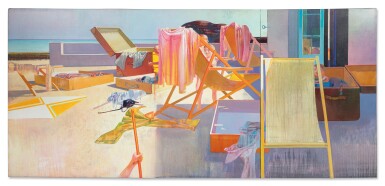
Executed between 1980 and 1982, La mise à nu du père belongs to the series of large-format works that Leonardo Cremonini devoted to the beach, a recurring space in his œuvre since his childhood on the Tyrrhenian coast. For the artist, the beach is as much a setting as a theatre of suspended human relations. The diptych, oil on canvas in two parts, is itself a formally significant device: the physical caesura between the two panels introduces a discontinuity into the represented space, a latent fracture that generates the psychological tension of the subject. The laying bare of the title is not that of the body but of the relationship between generations, between figures whose physical proximity does not preclude an irreducible inner distance.
Cremonini built his compositions from what he called "form and its meaning"; not a story to be told, but a structure to be inhabited. His figures seem to rest physically without ever resting mentally, and it is precisely this dissociation that La mise à nu du père embodies with particular acuity. Light, handled with the geometric precision that aligns Cremonini with Piero della Francesca as much as with Morandi, cuts the silhouettes without fully revealing them. The monumental scale amplifies this effect: the figures are close, physically imposing, and yet unreachable. La mise à nu du père belongs to a period of full critical recognition for Cremonini, and bears witness to an art of singular inward vision.
You May Also Like


