
Property from an Important Corporate Collection
Georges Mathieu
Illusions obscures
Estimate
60,000 - 80,000 EUR
Lot Details
Description
Georges Mathieu
1912 - 2012
Illusions obscures
signed (on the lower left) and titled (on the reverse on the stretcher)
alkyd on canvas
92 x 73 cm; 36 ¼ x 28 ¾ in.
Executed in 1989.
This artwork is referenced among the authentic artworks of the « Archives by Jean-Marie Cusinberche on Georges Mathieu ». An attestation of the « Archives by Jean-Marie Cusinberche on Georges Mathieu » will be provided to the buyer.
Galerie Protée, Paris
Private Collection, Rambouillet
Faure-Rey, Rambouillet, 13 May 1990
Piasa, Paris, 18 June 1997, lot 120
Meeting Art, Vercelli, 22 June 2002, lot 105
Galleria d'Arte Soave, Alessandria
Farsettiarte, Prato, 29 May 2010, lot 542
Galleria Biasutti & Biasutti, Turin
Private Collection
Artcurial, Paris, 5 December 2023, lot 29
Acquired from the above sale by the present owner
Alessandria, Galleria d'Arte Soave, Georges Mathieu, June - September 2005, no. 19, p. 35, illustrated
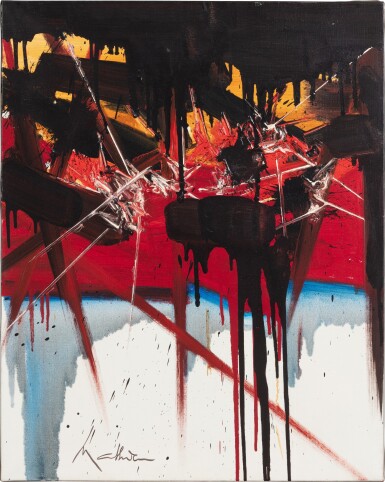
Executed in 1989, Illusions obscures belongs to the mature period of Georges Mathieu's work, in which the gestural vocabulary elaborated during the 1950s is reinvested with a new acuity. The shift to alkyd, a fast-drying synthetic medium that Mathieu adopted extensively in his later works, is a deliberate choice: more fluid and more rapid than oil, it aligns with the logic of an art founded on the primacy of speed and the impossibility of revision. On this more contained format, each mark is correspondingly more exposed, more sovereign.
The composition unfolds along a tension between restraint and proliferation. Calligraphic signs of dense whiteness, linear bursts, emerge from a dark ground with the precision of a script from which all lexical meaning has been abolished, leaving only its dynamic. The title, Illusions obscures, introduces a reflexive dimension rare in Mathieu's work: it suggests not an external subject but an interrogation of the nature of painting itself, of what the gesture claims to capture and what necessarily eludes it. The formal clarity of the sign and the opacity of the black ground thus enter into dialogue.
What Illusions obscures reveals with particular clarity is that maturity did not temper the gesture but distilled it. Mathieu intensifies what remains irreducible: the conviction that painting is, above all, an act of knowledge accomplished in the instant, and that the instant does not repeat itself.
You May Also Like


