
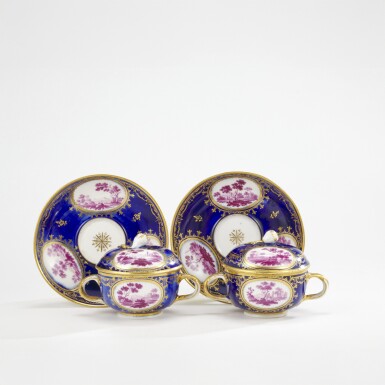
A rare pair of Naples Real Fabbrica Ferdinandea dark blue-ground porcelain écuelles, covers and stands, circa 1790
Lot Closed
March 26, 04:19 PM GMT
Estimate
800 - 1,200 EUR
Lot Details
Description
decorated ‘alla Doccia’ with puce camaïeu landscape vignettes within oval cartouches with gilt-scroll borders, the domed covers similarly decorated and with flower finial, one stand with crowned 'FR' mark in underglaze-blue, one écuelle incised 1. IX and the other 2. IX., the stands each with incised numerals
stand 14,5 cm, 5 ¾ in. diameter
écuelle 13,7 cm, 5 ⅜ in. wise across handles
With Segre padre & figlio, Rome (according to old collector’s label, present when sold in 2011)
With Lukacs-Donath, Rome;
Roberto Procida Mirabelli di Lauro Collection, Naples, no. 137, acquired from the above in 1975;
Bonhams, London, 25 May 2011, lot 92.
Naples, Museo Archeologico Nazionale, Le Porcellane dei Borbone di Napoli, Capodimonte e Real Fabbrica Ferdinandea 1743-1806, December 1986 - April 1987, no. 579.
A. Caròla-Perrotti, La Porcellana della Real Fabbrica Ferdinandea 1771-1806, Naples, 1978, no. 90, col. pl. LXXXIV (one example);
A. Caròla-Perrotti, Le Porcellane dei Borbone di Napoli, Capodimonte e Real Fabbrica Ferdinandea, 1743-1806, exhibition catalogue, Naples 1986, p. 585, no. 579, col. pl. XCVIII (one example).
Under the direction of Domenico Venuti in the 1780s, the Naples factory produced a small group of wares that reveal a strong influence of the Florentine factory of Doccia. Between 1784 and 1788-90 a new paste was introduced according to a formula developed by the Tuscan Giuseppe Bruschi who came to Naples in 1782 together with another Florentine, a cimico dei colori (colour chemist), called Nicola Pintucci. Correspondence between Venuti and another Tuscan, Pietro Giunini, reveals that progress had been made with the paste and that new ovens were created to produce 'esemplari perfetti [...] formati di porcellana della composizione e pasta di Doccia'. (perfect examples [...] made from porcelain comparable in composition and paste to that of Doccia). Doccia’s influence on the Real Ferdinandea factory is further indicated by the occasional production of wares directly copying Doccia, including in the 1790s, pieces decorated ‘a galli rossi’, one of Doccia’s most successful patterns. For further discussion of the influence of Doccia on the Naples manufactory see A. Caròla-Perrotti, Le Porcellane dei Borbone di Napoli, Capodimonte e Real Fabbrica Ferdinandea, 1743-1806, exhibition catalogue, Naples 1986, p. 583. The puce camaïeu landscapes and blue-ground decoration of this rare pair of écuelles, covers and stands, while emulating decoration seen at the Doccia factory, also suggests the overarching influence of the Sèvres manufactory on porcelain manufactories across Europe.