
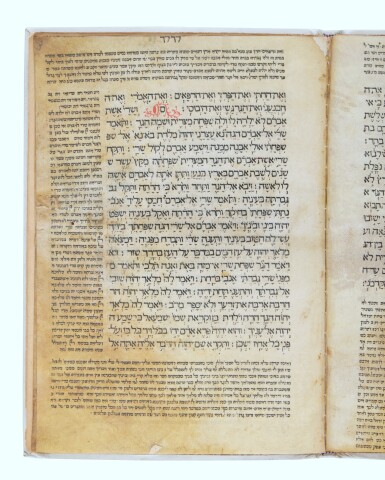
Pentateuch (Humash), with Targum Onkelos and Rashi’s Commentary, Printed on Parchment
Bologna: Abraham ben Hayyim dei Tintori, for Joseph ben Abraham Caravita; 5 Adar I 5242 (25 January 1482).
Estimate
6,000 - 8,000 USD
Lot Details
Description
Folios from the first Hebrew printing of the Pentateuch.
While one of the very first books issued from Gutenberg’s printing press was a copy of the Latin Bible, Jews did not print the Hebrew Bible until about twelve years after Hebrew printing began, around 1469. It has been suggested that this was due to the text’s special sanctity or the wide availability of manuscript copies, but the challenge of printing the Bible with vowels (nikudot) and cantillation marks (te’amim) was likely a factor as well. The man who printed the editio princeps of the Hebrew Pentateuch was Abraham ben Hayyim, with the financial backing of the banker Joseph ben Abraham Caravita. Beginning as a printer in Ferrara in the late 1470s, Abraham ben Hayyim subsequently moved to Mantua and later Bologna, where he worked for the press established by Caravita; in a later period, he was also associated with the famed Soncino press. It was in Bologna that he issued his extraordinary edition of this most sacred of texts, complete with full vocalization and cantillation marks, making it the first successful Hebrew book to include both. The text was edited by Joseph Hayyim ben Aaron Zarfati, who in the colophon praises the printer’s skill.
Another technically innovative feature of Abraham ben Hayyim’s edition was the inclusion of the traditional Aramaic translation of the text, Targum Onkelos, and the classic commentary of the great eleventh-century scholar Solomon ben Isaac (Rashi), in an integrated, tripartite page architecture with the biblical text: the Targum in a column at the outer margin and Rashi’s commentary above and below. While Rashi’s commentary had been printed before, this was the first time it appeared together with the biblical text. This printing of Rashi was later praised by the famous printer Gershom Soncino as the best version of the text. The Bologna layout, with Scripture, Targum and Rashi, set a model for subsequent editions of the Hebrew Bible. This landmark publication is often described as the most important Hebrew book ever printed.
The present copy was printed on vellum rather than on paper, a very expensive and technically demanding process. Most extant copies of this edition are similarly on vellum, perhaps owing to the perceived sanctity of the text and the desire to treat it similarly to a Torah scroll, traditionally written on parchment. Another feature connecting it to the manuscript medium is the presence of hand-drawn decorative floral flourishes in red and blue marking running titles and the start of sections. Such additions were common in manuscripts and appear in many early printed works as well.
Physical Description
Folio (275 x 190 mm); 11 leaves printed on parchment, from the first two quires: quire i, lacking leaves 5, 6, 9, and 10; quire ii, lacking leaves 11, 17, and 18. Script and layout: biblical text in one column in square type, fully vocalized and accented; Targum in a narrow outer column; Rashi in long lines above and below, both in semi-cursive type. Headlines present. Manuscript decoration/rubrication: running titles and selected parashiyyot markers with red floral penwork; parashah incipits embellished in blue, with red flourishes marking the opening of the corresponding Targum passage and blue flourishes for Rashi.
Binding: later vellum; gilt spine; all edges gilt; patterned cloth endpapers.
Provenance
The Chicago Theological Seminary; current owner.
Literature
Reference works: ISTC ib00525570; Goff Heb-18; Offenberg 13; Iakerson 19.
Shimon M. Iakerson, Catalogue of Hebrew Incunabula from the Collection of the Library of the Jewish Theological Seminary (New York, 2005).
You May Also Like

![MINHAGIM, SIMEON HA-LEVI GÜNZBURG, AMSTERDAM: ELIJAH ABOAB [AND MENASSEH BEN ISRAEL], 1645](https://dam.sothebys.com/dam/image/lot/a4242e18-268b-4827-8723-05a9dfee0d48/primary/extra_small)

![AN EXQUISITELY DECORATED EARLY ENGLISH TRANSLATION OF THE SIDDUR (DAILY PRAYER BOOK) ACCORDING TO THE SEPHARDIC RITE, [LONDON: CA. 1730-1750]](https://dam.sothebys.com/dam/image/lot/b5426d65-78d4-4c36-a4d7-d1d8ea3f99a9/primary/extra_small)


![An Elaborately Embroidered Passover and Festival Tablecloth, [Germany] 1779](https://dam.sothebys.com/dam/image/lot/8175a752-127a-4d74-b3c4-a91627f09823/primary/extra_small)


