
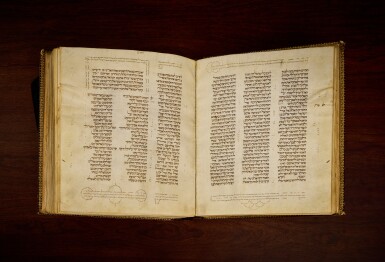
A Rare Hebrew Bible with Micrographic Masorah, Spain c. 1300
Estimate
1,500,000 - 2,500,000 USD
Lot Details
Description
A Rare Hebrew Bible with Micrographic Masorah
[Toledo, late 13th-early 14th century]
249 folios (10 1/4 x 9 in.; 260 x 230 mm), manuscript on parchment. Bound in elaborately blind-tooled dark brown nineteenth-century leather.
A magnificent Hebrew Bible from Spain.
The present lot is a masterfully copied medieval Hebrew Bible accompanied by the text-critical notes of the Masorah magna and Masorah parva in the upper and lower margins and between text columns, respectively. Based on its elegant calligraphy, it was produced within the Sephardic geo-cultural zone of the thirteenth century. We can narrow the location further by closely examining its codicology: almost all of its surviving quires are composed of ternions, that is, three bifolia comprising six folios or twelve pages. This particular method of manuscript construction has been linked specifically to scribes working in Toledo up to about 1300, perhaps due to the impact of a local Arab tradition that had crystallized when the city was under Muslim rule. (Most other Sephardic manuscripts, by contrast, were composed of quaternions, that is, four bifolia comprising eight folios or sixteen pages.)
Another indication of a connection to the city is the volume’s decorative program, an Islamic-influenced style found in several Toledo manuscripts that is characterized by geometric micrographic designs using the masoretic text in the margins and at the end of biblical books or pericopes.
One of these geometric designs, found at several points throughout the volume, takes the form of a Star of David.
The use of this motif in Hebrew biblical manuscripts goes back at least to early eleventh-century Egypt but spread with time to other parts of the Jewish world, including Iberia, Provence, and Germany. These book-art examples of Stars of David combine with others from medieval Jewish material culture more generally to argue in favor of a premodern date for the hexagram’s adoption as a distinctly (though not exclusively) Jewish symbol.
The attribution of this lot to Toledo is significant, as the city was renowned for the accuracy of the biblical codices originating therein. Indeed, one of the towering figures of high medieval Masorah studies, Rabbi Meir ha-Levi Abulafia (Ramah; ca. 1170-1244), author of the influential masoretic treatise Massoret seyag la-torah, lived and headed a yeshiva in Toledo. The city was also home to the celebrated Hilleli Codex, a legendary, ancient Hebrew Bible cited and used as an authoritative model by Iberian copyists from the early thirteenth through the fifteenth centuries but subsequently lost to history.
Finally, Toledo produced two particularly famous scribes, Israel ben Isaac Ben Israel (fl. 1222-1241) and Joseph ben Judah Ibn Merwas (fl. 1300-1334), whose work, some of which survives to the present day, was greatly esteemed and/or relied upon by the likes of Rabbis Menahem ben Solomon Me’iri (1249-1316), Isaac Abarbanel (1437-1508), and Moses ben Jacob Ibn Zabara (fifteenth century).
Between 1300 and 1334, Joseph ben Judah ibn Merwas copied and signed three Bibles. In 1300, he produced a Bible that is now in the British Library in London (MS Or. 2201). His second Bible, written in 1307, is currently in the Toronto University Library (Friedberg MSS 5-001) and in 1334, Ibn Merwas wrote a third Bible for Judah Ben Asher in Toledo. His Bibles, and especially his second from 1307, feature the imagery of the Star of David formed from expert micrographic lettering throughout the text.
The present bible, though unsigned, may well have been produced by Joseph ben Judah ibn Merwas, as the similarity of the elegant script and the use of the star of David micrographic designs, are strong indications that this manuscript was written and decorated by the celebrated scribe.
Some time after the manuscript’s completion, a later user with a neat Sephardic hand added headers, chapter numbers, and marginal haftarah (lection from the Prophets) references that cite the chapter in which the haftarah occurs. These modifications were presumably intended to make the volume more user-friendly in both the synagogue and the study hall. A still later, Judeo-Spanish-speaking owner seems to have continued where his predecessor left off by actually marking the starting point of haftarot in the books of Samuel through Isaiah.
Contents
The order of the preserved biblical books in the present lot mirrors that of ancient Masoretic Bibles such as the Aleppo Codex, the Leningrad Codex, and Codex Sassoon:
Torah (ff. 1r-34r)
ff. 1r-2v: Leviticus 16:25-19:13a, 26:37b-end
ff. 2v-15v: Numbers 1:1-26a, 4:26b-7:54a, 13:33b-21:23a, 23:10b-end
ff. 15v-34r: Deuteronomy
Prophets (ff. 35v-175r)
ff. 35v-47r: Joshua
ff. 47r-59r: Judges
ff. 59r-85v: I-II Samuel
ff. 85v-114v: I-II Kings
ff. 114v-122v: Isaiah 1:1-4a, 41:11-end
ff. 122v-148r: Jeremiah
ff. 148r-162v: Ezekiel 1:1-34:26
ff. 163r-175r: Amos 5:1-end of Twelve Minor Prophets
Writings (ff. 175v-249v)
ff. 175v-204v: I-II Chronicles
ff. 204v-230v: Psalms
ff. 231r-237r: Job 14:9-end
f. 237v: Proverbs 1:1-2:13
ff. 238r-239v: Esther 5:12b-end
ff. 239v-246v: Daniel
ff. 246v-249v: Ezra 1:1-8:12a
Provenance:
Asher Abarbanel (f. 7v); The Chicago Theological Seminary, Hammond Library; Current owner


![Paradis, Ung petit traicte de Alkimie, [Paris, before 1540], contemporary morocco by the Pecking Crow binder for Anne de Montmorency](https://dam.sothebys.com/dam/image/lot/0edc3dd8-deb5-48a1-847c-d0022dd67f58/primary/extra_small)

![Complete Cycle of Haftarot (Prophetic Readings), [Spain, 14th century]](https://dam.sothebys.com/dam/image/lot/21c5a5f1-1a12-40c9-a8f1-ff1c55cb81fa/primary/extra_small)


![A Rare Monumental Ashkenazic Torah Scroll, [Northern Italy, ca. 1400]](https://dam.sothebys.com/dam/image/lot/6afb4c0d-f904-4d49-b4b7-d47218989905/primary/extra_small)


