
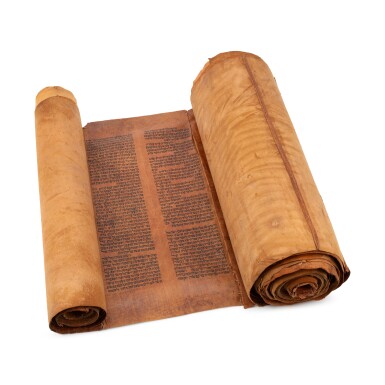
A Historic Yemenite Torah Scroll
Estimate
70,000 - 100,000 USD
Lot Details
Description
A rare witness to ancient Yemenite custom, the earliest portions carbon-dated to ca. 1425-1450.
The Yemenite community is one of Jewry’s oldest diasporas. Some of its customs echo those of ancient times, with no parallel known among other contemporary Jewish groups. One particularly noteworthy practice is their use of a distinctive square script in the copying of ritual scrolls like Torahs, tefillin, and mezuzot. The forms of the script’s letters harken back in certain respects to those current in Second Temple times and thereby constitute a living link to earlier periods of Jewish history.
As was true for other communities of Jews, the Hebrew script used by Yemenites evolved over time. It is possible to trace four key developments in its history. The earliest known Yemenite writing featured the letter shin with its middle limb connected to its leftmost extremity, as well as the letter kof with its descender connected to its roof. The first change was that the middle limb of the shin migrated to the letter’s base; next, the descender of the kof was separated from the roof; then, the roof of the letter het was broken in two with an arch connecting each side; and finally, the letters shin, ayin, tet, nun, zayin, gimel, and tsadeh were each adorned with three tagin (serifs) every time they appeared in the Torah.
The present scroll features examples of Yemenite writing from all of these stages. A little over a third comprises membranes wherein the shin’s middle limb is connected at left and the kof’s descender hangs from its roof (though a later hand would “correct” this by separating the roof from the descender). Another third or so consists of membranes whose writing represents the intermediate phases, wherein the shin and kof had lost these two characteristics. And a bit less than a third are more modern replacement sheets sewn in over the course of the Torah’s long history, attesting to repeated restoration campaigns as the scroll continued to be used for public reading. (Interestingly, membranes from all three groups demonstrate at least some fidelity to the custom of otiyyot meshunnot, according to which the graphic forms of specific instances of certain letters were modified.)
An even more remarkable characteristic of this Torah’s earliest stratum, mentioned in geonic literature, is the manner in which its scribe indicated the midpoint of verses with a single dot of ink placed under the relevant word. This mark was meant to signal to members of the community called upon to receive an aliyyah to the Torah where they should pause when reading each verse. (Yemenite Jews did not have the practice, virtually universal among other groups, of designating a single person to read all of the aliyyot.) Similarly, the scribe left extra space in between verses for the same purpose (though this feature can be found in premodern Ashkenazic Torah scrolls as well).
In later periods, Jewish legal authorities’ objections to the addition of these dots resulted in further developments, also evident in various parts of the present scroll. Some scribes replaced the ink dots with scratches on the epidermis of the writing surface. Others made circular impressions on the skins both under the verses’ midpoints and at their endpoints (and sometimes also in the margins, to mark new aliyyot). This Torah, with its multiple layers and writing styles, thus testifies to the variation and evolution of Yemenite scribal practice across the generations.
The scroll’s earliest sheets have been carbon-dated to approximately the second quarter of the fifteenth century, a period from which very few complete or substantially complete Yemenite Torahs are known to survive. Fewer than a dozen scrolls of such an early provenance (or earlier) are recorded in worldwide public collections: London, British Library, Or. 1451-1458; Cambridge, Trinity College, Ms. 159; and Berlin, Staatsbibliothek, Ms. Or. 1209. Moreover, the present lot is apparently one of only three extant Yemenite Torahs (or fragments thereof) that bear witness to the use of the ink dot to mark verses’ midpoints. Its historic value cannot easily be overstated.
Sotheby’s is grateful to Mordechai Weintraub and Yehoshua Yankelewitz for providing information that aided in the cataloging of this Torah scroll.
Physical Description
Scroll of 76 membranes of varying heights (approx. 23 in. x 99 ft.; approx. 583 mm x 30.19 m) made of gevil (parchment processed for writing on the hair side only and prepared with mei afatsim [gallnut solution]); written in Yemenite square script in black ink with one to five columns per membrane (membrane widths ranging from approx. 4 1/2 to 28 1/2 in.; approx. 115 to 720 mm) (total: 227[!] columns), and fifty or fifty-one lines per column; horizontally and vertically ruled in hardpoint on the recto; corrections in hands of primary and secondary scribes. The Songs of the Sea (Ex. 15:1-19) and of Moses (Deut. 32:1-43) are laid out to look like brickwork (ariah al gabbei levenah and ariah al gabbei ariah, respectively); majuscular, minuscular, dotted, and otiyyot meshunnot (anomalous letter-forms) customs usually observed; midpoints and endpoints of verses sometimes spaced and/or dotted.
Literature
Eylon Aslan-Levy, “University of Cambridge Students Read From 14th Century Torah Scroll at Morning Service,” Tablet Magazine (March 10, 2016), available at: https://www.tabletmag.com/sections/news/articles/university-of-cambridge-students-read-from-14th-century-torah-scroll-at-shacharit-service.
Mordechai Weintraub, “Simanim paratekstu’aliyyim be-sifrei torah” (MA thesis, Hebrew University of Jerusalem, 2021), 17, 43-45.
You May Also Like


![MINHAGIM, SIMEON HA-LEVI GÜNZBURG, AMSTERDAM: ELIJAH ABOAB [AND MENASSEH BEN ISRAEL], 1645](https://dam.sothebys.com/dam/image/lot/a4242e18-268b-4827-8723-05a9dfee0d48/primary/extra_small)
![Diogenes Laertius, Epistolae Bruti, [Venice, 1492], binding by Mahieu's Aesop Binder for Jean Grolier](https://dam.sothebys.com/dam/image/lot/1f338a84-3760-4404-b6bd-39b63c6fcdd2/primary/extra_small)
![An Elaborately Embroidered Passover and Festival Tablecloth, [Germany] 1779](https://dam.sothebys.com/dam/image/lot/8175a752-127a-4d74-b3c4-a91627f09823/primary/extra_small)

![Paradis, Ung petit traicte de Alkimie, [Paris, before 1540], contemporary morocco by the Pecking Crow binder for Anne de Montmorency](https://dam.sothebys.com/dam/image/lot/0edc3dd8-deb5-48a1-847c-d0022dd67f58/primary/extra_small)

![MINIATURE TORAH SCROLL, [EASTERN EUROPE: LATE 19TH-EARLY 20TH CENTURIES]](https://dam.sothebys.com/dam/image/lot/b8774ad8-b308-4283-94cf-9489af2a055b/primary/extra_small)

