
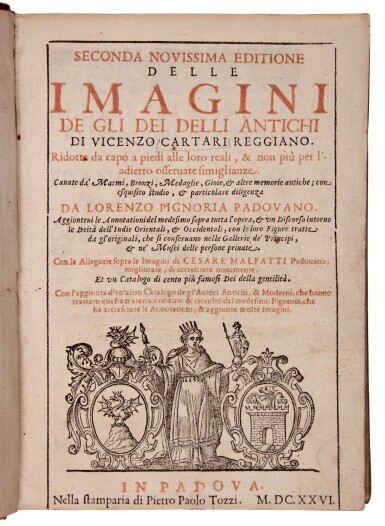
Cartari, Seconda novissima editione delle imagini de gli dei, Padua, 1626, contemporary vellum
Lot closes
December 17, 11:04 AM GMT
Estimate
200 - 300 EUR
Current Bid
50 EUR
1 Bid
No reserve
We may charge or debit your saved payment method subject to the terms set out in our Conditions of Business for Buyers.
Read more.Lot Details
Description
CARTARI, VINCENZO. Seconda novissima editione delle imagini de gli dei delli antichi di Vicenzo Cartari reggiano. Ridotte da capo a piedi alle loro reali, & non più per l'adietro osservate simiglianze. Cavate da' Marmi, Bronzi, Medaglie, Gioie, & altre memorie antiche; con esquisito studio, & da particolare diligenza da Lorenzo Pignoria Padovano. Aggiontevi le annotationi del medesimo sopra tutta l'opera… Con le Allegorie sopra le Imagini di Cesare Malfatti Padovano… Et un Catalogo di cento più famosi Dei della gentilità. Con l'aggiunta d'un'altro Catalogo de gl'Autori Antichi, & Moderni, che hanno trattato questa materia, ordinato & raccolto dal medesimo Pignoria… Padua: Pietro Paolo Tozzi, 1626
This is a reprint of Lorenzo Pignoria's 1615 revised edition of Vincenzo Cartari's Le imagini de i dei de gli antichi, a compendium of Greco-Roman Gods. Pignoria's revisions to Cartari's work focused the work on a history of idolatry, and he added a seconda parte, which addresses 'Indian Gods'. In this treatise he draws comparison between Mexican drawings of idols, and the iconography of Ancient Egypt. He also includes images of a series of 'Japanese figures', drawn from reports provided by Jesuit missionaries.
Significantly, Pignoria criticised the illustrations that had been included in previous editions of Cartari's work, and he commissioned Filippo Ferroverde to produce woodcuts that were based on archaeological research and drawn from artefacts, rather than relying on descriptions.
4to (218 x 154 mm). Roman type, 43 lines plus headline. Collation: π2 +8 a6 A-Z8 Aa-Ll8 ++2 Mm-Oo8: 313 leaves (of 314, without final blank). Half-title, title-page printed in red and black with woodcut printer's device, woodcut initials, head- and tailpieces, numerous woodcut illustrations, two folding woodcut plates. (Title-page shaved at foot, marginal rust hole to D5-8, 2O1 becoming detached with tear at gutter, 2M3 two marginal holes, 2D7 small marginal hole, I8 marginal hole and repair, occasional light staining or browning).
Binding: Seventeenth-century vellum (224 x 162 mm), paper label on spine with manuscript lettering. (Binding lightly soiled, paper label slightly defective.)
Provenance: Petit Seminaire d'Auxerre, blue ink stamp to half-title and verso of 2O7. Acquisition: Purchased in 1990 from Diana Parikian, Oxford. References: USTC 4003699; P. von Wyss-Giacosa, 'Through the Eyes of Idolatry: Pignoria's 1615 Argument on the Conformità of Idols from the West and East Indies with Egyptian Gods' in Through your eyes: religious alterity and the early modern Western imagination (2021), 103-144