
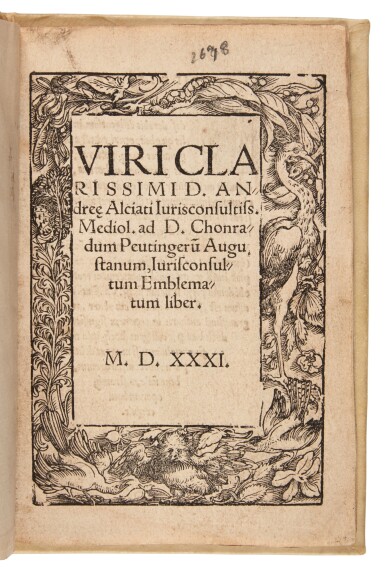
Alciati, Emblematum liber, Augsburg, 1531, with an autograph letter by Alciati, later vellum
Lot closes
December 17, 10:10 AM GMT
Estimate
40,000 - 60,000 EUR
Starting Bid
40,000 EUR
We may charge or debit your saved payment method subject to the terms set out in our Conditions of Business for Buyers.
Read more.Lot Details
Description
ALCIATI, ANDREA. Viri clarissimi D. Andree Alciati Iurisconsultiss. Mediol. ad D. Chonradum Peutingerum Augustanum, Iurisconsultum Emblematum liber. (Augsburg: Heinrich Steiner, 28 February) 1531
FIRST EDITION OF THE FIRST EMBLEM BOOK. It was published by Conrad Peutinger, a friend of Alciati's, though quite possibly without Alciati's approval or involvement. It was printed by Heinrich Steiner, who quickly reprinted it in April that same year with the errata corrected. The woodcut illustrations are now attributed to Jörg Breu the elder (c. 1475/80-1537), who provided numerous illustrations for Augsburg printers.
Alciati's emblems were derived from nature, mythology and history, mostly via classical or medieval sources, as well as Erasmus's Adagia. They each contain a motto with an epigram, to which illustrations were subsequently added by the printers. Alciati described his compilation as taking something from history or nature and giving it meaning which could then be used by an artist or craftsman to provide a badge or device; he mentions the dolphin and anchor device of Aldo Manuzio as well as Francesco Calvo's elephant printer's device (Karl Enenkel, The Invention of the Emblem Book and the Transmission of Knowledge, Brill, 2019, p. 4). It has also been suggested that Alciati could have devised his work as a literary coin and medal cabinet for his friend Peutinger.
Alciati's little book proved a commercial success and was subsequently translated into various languages with illustrations by artists such as Jost Amman, Virgil Solis and Bernard Salomon and expanded over time from around 100 to over 200 emblems. Its influence on European culture led to the production of other emblem books and the extensive use of Alciati's symbolism in diverse contexts.
TOGETHER WITH AN AUTOGRAPH LETTER BY ALCIATI, addressed to the bookseller and printer Francesco Minizio Calvo (active 1516-1545, in Pavia, Rome and Milan), who moved to Rome in 1521. One of Calvo's first publications in Rome was Marliani's Oratio in Martinum Lutherum, with some anti-Lutheran verses signed "Paulus exorcista", who has been identified as Alciati, though Calvo does not seem to have published any of Alciati's own works. Alciati and Calvo were regular correspondents during the 1520s, when Calvo had connections to the Papal Curia.
Loosely inserted in the volume is a printed form headed "Report from Messrs. Ellis, 29 New Bond Street" with four extracts from sale catalogues pasted onto it, and dated 24 December 1912; one of the four is for a copy of the 1531 Alciati in vellum. There is also the extract from the Sotheby's 1916 catalogue of autographs, with the price £6-10-0.
8vo (147 x 96 mm). Italic type. Collation: A-E8 F4: 44 leaves (last leaf blank), with errata on F3v verso. Title within a woodcut border, woodcut initials and illustrations.
Autograph letter signed ("Alciatus tuus"), to Francesco [Minizio] Calvo, "mercante de libri" (bookseller) in Rome, dated 13 June 1521, arranging letters of introduction on behalf of his friend M. Antonio Capello, and Capello's friend Giovanni Matteo Colombo, which Alciati has already requested from [Mario] Salamonio, 7 lines, tipped onto flyleaf. (Folded with small tear along crease, a few very small holes, address panel slightly browned.)
Binding: Modern vellum (152 x 104 mm), spine lettered in black, in black leather folding box.
Provenance: book: [perhaps William Wheeler Smith of New York, sale, Sotheby's, London, 13 December 1909, lot 15, described as having a vellum binding in a black pigskin slipcase] — Allan Heywood Bright (1862-1941), bookplate dated 1912 — Yates, Thompson and Bright: a family of bibliophiles, sale, Christie's, London, 16 July 2014, lot 40; letter: sale, Sotheby's, 31 July 1916, £6-10s, presumably added to the book by Allan Heywood Bright. Acquisition: Purchased at Christie's sale in 2014. References: Green, Alciati 2; Landwehr, German Emblem Books 23; VD16 A 1641