
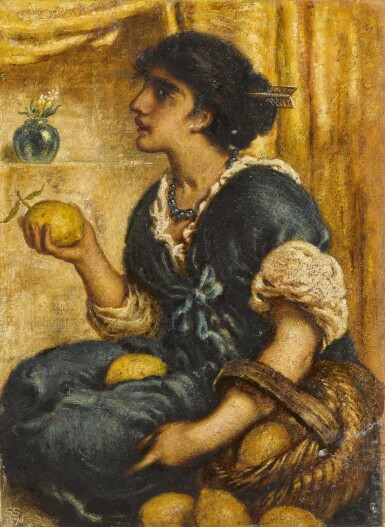
Property from an Italian Private Collection
Simeon Solomon
The Lemon Seller
Live auction begins in:
02:15:21
•
December 4, 03:00 PM GMT
Estimate
10,000 - 15,000 GBP
Bid
9,000 GBP
Lot Details
Description
Property from an Italian Private Collection
Simeon Solomon
London 1840–1905
The Lemon Seller
signed with initials and dated lower left: SS / 1876
oil on board
unframed: 31 x 22cm.; 12¼ x 8½in.
framed: 56.5 x 48.3cm.; 22¼ x 19in.
Probably purchased from the artist by his cousin, Myer Salaman;
Thence to his daughter, Mrs Herman Cohen, by 1905;
Purchased by the parents of the present owner from a British private collection in 1975;
Thence by descent.
London, Baillie Gallery, Paintings and Drawings by the Late Simeon Solomon, 9 December 1905 – 13 January 1906, no. 8 (lent by 'Mrs Hermann Cohn').
This delightful oil by Simeon Solomon is typically enigmatic. At first it seems to be a straight-forward depiction of a young Italian girl selling lemons and part of a long tradition of painting picturesque hawkers selling fruit or flowers whether in Covent Garden or the street markets of Capri or the Spanish Steps in Rome. However, into the girl’s hair Solomon has inserted a golden arrow. This ambiguous and incongruous element almost certainly has a symbolic reference – perhaps it suggests that the girl is a ‘victim’ of Cupid’s wounding arrows. There may also be a suggestion of the contrast between the sweet beauty of the girl and the sour taste of the lemon.
Although Solomon did paint and draw from female models, there are very few pictures by him which appear to depict Italian girls. Italian models of both genders were popular with Pre-Raphaelite painters and Solomon had employed several of the beautiful Italian male models who worked in Rome, Paris and London, including Portrait of an Italian Youth of 1869 (University of Wales, Aberystwyth), In the Summer Twilight of 1869 (sold in these rooms, 12 July 2018, lot 9) and the superb watercolour Bacchus of 1867 (sold in these rooms, 12 July 2018, lot 11). Solomon first visited Italy in 1866 when he visited Florence to study the Old Masters and he returned to Italy in April 1869 and again in 1870 when he stayed in Rome. It was whilst he was in Rome that he gained an appreciation for the professional models who were employed by the artists in the capital although. In London he discovered a young musician named Gaetano Meo playing his harp on Gower Street one day and he soon became his favourite model, not only for Solomon but for all his friends.
Solomon's visits to Italy were made in happy, prosperous times for Solomon but by 1876 when The Lemon Seller was painted, his reputation, his career and the stability of his life had started to unravel. In 1873 he was sentenced to eighteen months in prison and in 1874 he had spent three months in a Parisian prison after being arrested for an ‘indecent act’. This was the catalyst that led to the decline in his circumstances, seeing him living at the St Giles’s Workhouse intermittently for twenty years blighted by alcoholism and extreme poverty.
When The Lemon Seller was exhibited at Solomon's memorial show at the Baillie Gallery in 1906 it was lent by 'Mrs Hermann Cohn' who also lent The Winged and Poppied Sleep of 1883, Portrait of an Englishwoman and also Cupid dated 1883. It seems that her name was misspelt in the catalogue because the owner was Mrs Herman Joseph Cohen - Bessie, daughter of Solomon's first cousin Myer Salaman a successful wholesale dealer in ostrich feathers for the millinery industry. Salaman had supported the artist in his times of need – he paid Solomon’s bail when he was arrested in 1873 and was one of the few who tried to help by providing him with clothes and money. In the days after Solomon's death, Salaman wrote; '"He was a clever artist, and at the time of his death had commissions from people in high society. Sometimes he did the work, and sometimes he didn't. His weakness for drink dragged him down."' (Newcastle Daily Chronicle, 19 August 1905, p. 6).
You May Also Like


