
Albert-Ernest Carrier-Belleuse
La Confidence (The Secret)
Live auction begins in:
02:32:09
•
December 4, 03:00 PM GMT
Estimate
10,000 - 15,000 GBP
Bid
7,000 GBP
Lot Details
Description
Albert-Ernest Carrier-Belleuse
French
1824 - 1887
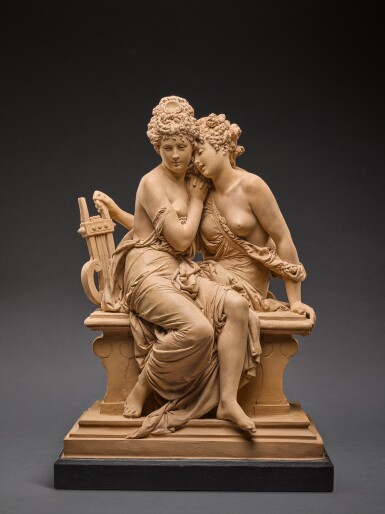
La Confidence (The Secret)
signed: A. CARRiER
terracotta, on an ebonised wood base
68 by 47 by 31cm., 26¾ by 18½ by 12¼in.
Albert-Ernest Carrier-Belleuse was one of the most important and innovative sculptors of nineteenth-century France. During his long career at the Paris Salon and beyond, Carrier-Belleuse was responsible for important public monuments, as well as creating decorative sculpture for a diverse clientele. His terracotta models, many of which depict playful mythological subjects, were reproduced widely. Carrier-Belleuse’s prolific workshop became an important training ground for younger sculptors, notably Auguste Rodin, who acted as the master’s assistant between 1864 and 1870.
This intimate group is described by June Hargrove as ‘two ravishing nymphs seated on opposite sides of a bench, leaning toward each other. One terminates her confidence with a sigh. Her friend contemplates the tale. Hooking her joined hands over the other’s shoulder, their draperies slip heedlessly down to reveal their splendid bodies, implying, in Greuzian fashion, the nature of their confidences’ (Hargrove, op. cit., p. 247).
Carrier-Belleuse’s composition dates from the early 1870s, and in the early 1880s he returned to the formula of La Confidence in a group entitled Les Frissionnes (ibid., pl. 231). The poses in the later group are almost identical, but the costumes of the women have been entirely revised as instead of vaguely classical drapery, Carrier-Belleuse depicted the young girls in pseudo-Italian provincial dresses and holding a jug to replace the lyre in the original composition (ibid., p. 248). Such ‘modish’ apparel began appearing more frequently in Carrier-Belleuse’s work as fashions moved away from the classicising features of his earlier oeuvre. As Hargrove notes, the later iteration of the group has lost the ‘wistfulness’ of the present terracotta as many of his later groups reworked from previous compositions tended to be drier and more mechanical than their earlier versions.
RELATED LITERATURE
J. Hargrove and G. Grandjean, Carrier-Belleuse. Le maître de Rodin, exh. cat., Palais de Compiègne, Paris, 2014; J. Hargrove, The Life and Work of Albert Carrier-Belleuse, New York and London, 1977, pp. 247-248, pl. 229 and 231
You May Also Like


