
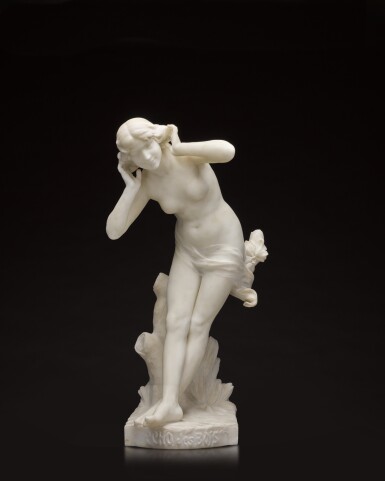
Henri Plé
Écho des Bois
Live auction begins in:
02:19:07
•
December 4, 03:00 PM GMT
Estimate
10,000 - 15,000 GBP
Bid
8,000 GBP
Lot Details
Description
Henri Plé
French
1853 - 1922
Écho des Bois
signed: Henri Plé and entitled: ECHO des BOIS
white marble
72cm., 28⅜in.
A Parisian by birth, Henri-Honoré Plé is known for his eclecticism and range of artistic talents. Practicing as both a painter and a sculptor, his works usually exhibit proud and powerful masculine figures, largely concerning history and mythology. His appreciation for the latter most likely derives from his instruction under Mathurin Moreau, whose combination of a passion of the antique and a personal flair for invention seep their way into Plé’s œuvre.
Indeed Plé’s Echo would not be out of place among Moreau’s collection of nubile nymphs; both artists share in their sculptures a love for the tradition, canonised by Carrier-Belleuse, of virtuoso draperies and vibrant females. Although Plé’s figure of Echo is largely indebted to Alexandre Cabanel’s fantastical depiction of the same subject in 1874, the sculptor abandons the intense shock of the painted Echo in favour of an expression exuding warmth and serenity, exhibiting a wistfulness that anticipates the tragedy that would later befall her.
Plé’s Echo des Bois reflects the varied work of an artist who achieved notable success and popularity in the late nineteenth century. After debuting at the Paris Salon in 1877, Plé quickly gained recognition—earning an honourable mention in 1879 and a third-class medal in 1880. Although his career plateaued in the late 1890s, this period produced Echo in 1896, which ranks among Plé’s most beautiful and important marbles. Two years later he was awarded the second-class medal at the Salon, and in 1900 was deemed deserving of a bronze medal at the Exposition Universelle.
The mythological narrative of Echo originates from Ovidian poetry and is the Oread – a nymph residing in the mountains of Cithaeron – integral to the story of Narcissus, whose self-absorption and obsession with himself eventually led to his death. Echo’s role in the myth is as a victim of desperate tragedy; her intense love for Narcissus was not only unrequited, but she was never able to express to him the immensity of her affection. On Narcissus’ death after decaying as he gazed at his own reflection, Echo still mourned after him despite his self-infatuation, and slowly wasted away herself, her voice remaining an eternal memento.
RELATED LITERATURE
M. Forrest, Art Bronzes, Pennsylvania, 1988, p. 481; P. Kjellberg, Bronzes of the 19th Century: Dictionary of Sculptors, Pennsylvania, 1994, pp. 548-9; E. Benezit, Dictionnaire critique et documentaire des Peintres, Sculpteurs, Dessinateurs et Graveurs, Paris, 1999, p. 59
You May Also Like


