
The Property of a Gentleman
Teshigahara Sofu
The Sun (Nichirin)
Lot Closed
October 31, 01:03 PM GMT
Estimate
25,000 - 30,000 GBP
Lot Details
Description
The Property of a Gentleman
Teshigahara Sofu (1900-1979)
The Sun (Nichirin)
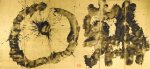
a six-panel folding screen: sumi ink and gold on paper, signed with artist's red seal, black lacquer mounts, pierced and engraved copper mounts
172 x 375 cm., 67¾ x 147⅝ in. (when unfolded)
Teshigahara Sofu, the Picasso of Flowers
‘The recent sculpture of the master Teshigahara Sofu has served as a major step in establishing a new aesthetic […]. Until a new order is born, “adjacency” is the most abstract concept we have. The term “composition”, which now enjoys currency in aesthetics and art criticism, is too classical, and I am even of the opinion that it should be replaced with “arrangement […]’– Michel Tapié1
Founded by artist and master of ikebana Teshigahara Sofu, the forty-ninth rule of the Sogetsu school of modern flower arrangement states the core underlying tenets of Teshigahara’s philosophy of art:
The four principles of freshness, motion, balance and harmony. The three elements of line, color and mass.
Extrapolating from flower arrangement to sculpture, painting and avant-garde calligraphy, Teshigahara began creating diverse forms of art using forms partly modelled by nature. He first exhibited as a sculptor at Tokyo’s Bridgestone Museum in 1957, subsequently gaining acclaim in the West through French critic-curator Michel Tapié, the organizer of Teshigahara’s first European solo exhibition at Galerie Stadler in Paris in 1959. In personal notes written during his first trip to Japan in 1957, Tapié raves:
‘Upon meeting [Teshigahara] for the first time, I sensed that I was before one of those exceptional creative talents who could present his work to the world. That kind of creativity is rare. After Picasso, I have been overawed by such presence only before the work of Pollock.’2
Here, the characters Nichirin, or sun disc, are boldly inscribed across the panels of the gold ground screen. The first character is rendered in its archaic pictorial form, more closely representing the circular form of the sun than its modern-day Japanese equivalent. The central accent radiates outwards, the ink splattering in explosive force within the incomplete circular border. The second character, which can be read wa or rin, signifies a ring and is formed as a concentrated cluster of fifteen-strokes. For another example of six-panel folding screen inscribed with the same characters, see Makoto Ooka et. al., Sofu Teshigahara: Calligraphies and Sculptures, (Tokyo, 1980), fig. 8.
Dubbed the ‘Picasso of Flowers’ by TIME Magazine, Teshigahara was awarded the Order of Arts and Letters by the French government in 1960 and the Legion of Honor in 1961.
According to Oshima Seiji, Director of the Setagaya Art Museum, Teshigahara was ‘gifted with the power of discerning artistic elements immanent in every detail of our life’.3 Apart from his own artistic career, Teshigahara demonstrated a passion for contemporary music and other art forms, founding the Sogetsu Art Center in 1958 along with his son Teshigahara Hiroshi. Operating from 1959 to 1971, the Sogetsu Art Center was the singularly most important platform for international intellectual and cultural exchange in post-war Japan, operating an ambitious program that invited and collaborated with international figures such as Georges Mathieu, Sam Francis, Mark Tobey, Olivier Messiaen and John Cage. Commissioning a large volume of works, Teshigahara acted as a patron to young artists from both Japan and abroad, supporting the careers of artists such as Toshimitsu Imai, Mathieu and Francis, amongst others. The friendship between Teshigahara and American artist and landscape architect Noguchi Isamu was also widely documented, the latter creating a sky garden for Teshigahara’s Sogetsu Kaikan. Teshigahara’s legacy, encompassing both his own art and the direct influence of others, is thus a hagiography like that of no other twentieth century visual artist in Japan.
1. Michel Tapié, in “A Mental Reckoning of My First Trip to Japan (1957)”, in From Postwar to Postmodern: Art in Japan 1945-1989, (New York, 2012), p. 99-100.
2. ibid.
3. Thomas Havens, Radicals and Realists in the Japanese Nonverbal Arts: The Avant-garde Rejection of Modernism, (Honolulu, 2006), p. 105.
You May Also Like

![Sakai Hoitsu (1761-1828), The Jewel River at Chofu (Chofu no Tamagawa), Edo period, dated Kinoto mi shoto (10th month in the Year of the Wood Snake [1785]) | 酒井抱一 調布の玉河図 江戸時代 天明五年 十月](https://sothebys-md.brightspotcdn.com/dims4/default/302bc21/2147483647/strip/true/crop/788x2000+0+0/resize/150x381!/quality/90/?url=http%3A%2F%2Fsothebys-brightspot.s3.amazonaws.com%2Fmedia-desk%2Fwebnative%2Fimages%2Fe4%2Fb7%2F136ca4124188b61cce19b9da469f%2Fhk1785-dlsgl-t3-02.jpg)


![Maruyama Okyo (1733–1795), Bush warbler in a plum tree, Edo period, dated Tenmei kinoe tatsu chuto sha (Painted in the 11th month in the Year of the Wood Dragon [1784]) | 円山応挙 梅に鶯図 江戸時代中期 天明甲辰仲冬写](https://sothebys-md.brightspotcdn.com/dims4/default/eca799a/2147483647/strip/true/crop/613x2000+0+0/resize/150x489!/quality/90/?url=http%3A%2F%2Fsothebys-brightspot.s3.amazonaws.com%2Fmedia-desk%2Fwebnative%2Fimages%2Fde%2Fd9%2F836b13ed4b93911bb5c876226a3d%2Fhk1785-dlsgv-t3-01-cropped.jpg)

